Blepharoplasty for Men: What to Consider Before Eyelid Surgery
Updated: Sep 30

Blepharoplasty for men may involve the upper eyelids, lower eyelids or both.
Planning depends on the concern being treated, the structures contributing to it and the changes being considered.
Published medical literature also describes anatomical characteristics that may be relevant when assessing male eyelids and brows.
Why Men Consider Blepharoplasty
Men may consider blepharoplasty because of heavy or hooded upper eyelids, under-eye bags, lower-eyelid fullness or changes around the eyes that create a tired or heavy appearance.
In some cases, excess upper-eyelid skin can interfere with the upper part of the visual field.
The main concern differs between patients.
One person may be concerned primarily about upper-eyelid hooding, while another may be more concerned about lower-eyelid bags, asymmetry or a combination of changes.
A Heavy Upper Eyelid Is Not Always Just Excess Skin

Upper-eyelid heaviness or hooding can result from more than one anatomical factor.
Upper-Eyelid Skin
Excess upper-eyelid skin, sometimes described medically as dermatochalasis, can fold over the natural eyelid crease and contribute to hooding. Upper blepharoplasty may be considered when excess skin forms an important part of the problem.
Brow Position
A low or drooping brow can add to upper-eyelid hooding. Medical literature on upper-eyelid surgery therefore considers the relationship between the brow and upper eyelid.
Eyelid Position
True eyelid ptosis is different from excess skin. In ptosis, the upper-eyelid margin itself sits lower than expected.
Eyelid fullness, fat distribution and surrounding tissues can also influence the appearance of the upper eyelid.
Distinguishing between these causes is important because they do not necessarily require the same treatment.
How Male Eyelid and Brow Anatomy Can Influence Planning

Published medical literature describes anatomical patterns in male eyelids and brows that may influence surgical planning.
These can include differences in brow position, eyelid crease, eyelid fullness and the distribution of surrounding tissues.
Male-specific surgical studies have also reported variations in how skin, muscle and fat were treated in the patient groups studied.
These findings are general observations rather than fixed rules. Age, ethnicity, genetics and facial anatomy can all influence eyelid shape and surrounding structures.
The purpose of considering these features is not to create a standardised male eyelid appearance, but to understand the anatomy relevant to the proposed operation.
Blepharoplasty Is Not Simply About Removing More Skin
Blepharoplasty is not simply a question of how much skin or fat can be removed.
Tissue removal has to be balanced with eyelid closure, eye comfort, function and the existing volume of the eyelid.
NHS patient guidance notes that excessive skin removal can affect eyelid closure and leave the eye dry and uncomfortable.
Surgical literature also describes conservative and volume-preserving approaches rather than excessive tissue removal.
Upper-eyelid fullness may form part of the existing appearance, so removing additional tissue is not automatically preferable.
Upper and Lower Blepharoplasty Address Different Concerns

Upper and lower blepharoplasty involve different anatomical areas.
Upper blepharoplasty commonly addresses excess upper-eyelid tissue. Depending on the proposed operation, skin, fat or a small amount of muscle may be treated.
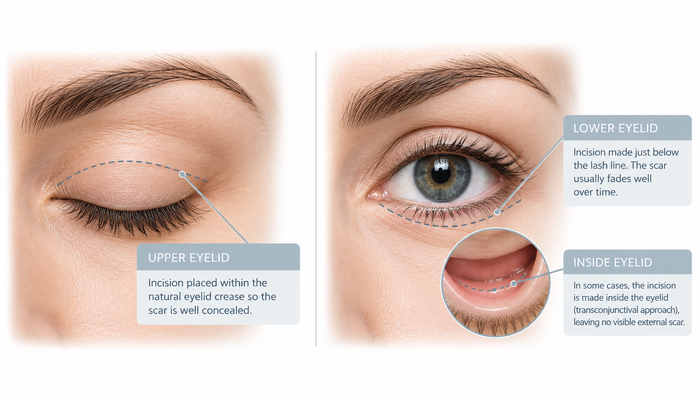
The incision is generally placed within the natural upper-eyelid crease.
Lower blepharoplasty more often addresses under-eye bags, protruding fat or skin excess. Fat may be removed or repositioned, and additional lower-eyelid support may sometimes be required.
The incision may be placed beneath the lower lashes or inside the lower eyelid depending on the surgical technique.
Upper and lower procedures may also be performed together when treatment of both areas is considered appropriate.
How Much Change Is Appropriate?
Eyelid surgery can alter facial appearance, so the intended degree of change is an important part of planning.
For some male patients, the aim may be to reduce upper-eyelid heaviness or lower-eyelid bags while retaining features such as the existing brow position, eyelid crease or some upper-eyelid fullness.
This allows the discussion to address two separate questions: what the patient would like to change and what they would prefer to preserve.
The General Medical Council requires the medical professional carrying out a cosmetic intervention to discuss expectations and limitations and provide enough information for an informed decision.
Eye Health and Medical Suitability Before Blepharoplasty

Relevant medical and eye history can affect suitability, surgical technique or risk.
Existing dry-eye symptoms, previous eye surgery, previous eyelid procedures, medicines and relevant medical conditions may all be important.
A history of dry or gritty eyes does not automatically mean that blepharoplasty cannot be considered.
However, surgery can temporarily worsen dryness or irritation in some patients.
Pre-operative literature supports consideration of factors that may affect eyelid function and eye comfort.
The Royal College of Surgeons also advises that the surgeon should know about medicines being taken before surgery.
Where Are Blepharoplasty Scars Usually Placed?
Upper blepharoplasty generally uses an incision along the natural upper-eyelid crease, placing the scar within an existing fold.
For lower blepharoplasty, the incision may be positioned just beneath the lower eyelashes or on the inside of the lower eyelid.
The approach depends on the structures being treated and the proposed surgical technique.
Scars change as healing progresses and vary between patients. No surgical scar should be described as invisible.
Recovery: Looking Recovered Is Not the Same as Being Fully Healed
Early recovery after blepharoplasty may include bruising, swelling, temporary numbness, irritation or watery eyes.
These changes generally improve with time, but visible recovery and complete healing do not occur at the same point.
NHS guidance states that many people take about two weeks away from work, depending on their job.
Bruising and redness may take several weeks to fade, while scars can remain visible or feel tight for a number of months.
Recovery can also differ between upper, lower and combined procedures. Work requirements, usual activities and clinical advice can affect when particular activities are resumed.
Risks and Limitations to Understand Before Surgery
All surgery has risks, and blepharoplasty is no exception.
Possible problems can include bleeding, infection, asymmetry, noticeable scarring, temporary changes in eyelid sensation, dry or irritated eyes and difficulty closing the eyelids fully.
Blurred or double vision can occur.
Lower-eyelid surgery can also carry a risk of the lower lid turning outwards, known as ectropion, or being pulled down.
Rarely, bleeding into the eye socket can cause serious visual problems. The NHS describes visual impairment as a rare but potentially serious complication.
The level and type of risk can be influenced by the operation being considered, anatomy, medical history and eye health.
A particular cosmetic result cannot be guaranteed. Further assessment or treatment may sometimes be required if healing or the outcome does not develop as expected.
Reviewing Before-and-After Photographs
Before-and-after photographs can show examples of blepharoplasty performed by a surgeon, but they cannot predict another patient's result.
The Royal College of Surgeons advises that patients can ask to see photographs of procedures performed personally by the surgeon.
For male blepharoplasty, photographs involving comparable concerns may help illustrate the surgeon's previous work.
Differences in age, anatomy, brow position, skin quality and starting eyelid shape, however, limit direct comparison between patients.
Professor Ben Miranda’s blepharoplasty before-and-after photographs provide examples of his previous work.
What Should Be Discussed at a Blepharoplasty Consultation?
A blepharoplasty consultation allows the surgeon to identify the main concern, assess the eyelids and surrounding structures, and review relevant health information.
This may include medical and eye history, previous eye or facial surgery, current medicines and factors that could affect eyelid function or eye comfort.
The surgeon can then discuss the proposed procedure, alternatives, risks, limitations, likely scar position, recovery and aftercare in relation to the clinical findings and the changes the patient hopes to achieve.
The General Medical Council states that the medical professional carrying out the cosmetic intervention is responsible for discussing it with the patient and seeking consent.
The Royal College of Surgeons similarly advises that the consultation should be with the surgeon performing the operation.
Taking Time Before Deciding
Cosmetic eyelid surgery should not require an immediate decision.
The Royal College of Surgeons strongly advises allowing at least two weeks after consultation with the operating surgeon to think things through before cosmetic surgery.
GMC guidance also requires sufficient time for reflection so that consent remains informed and voluntary.
There should be no pressure to proceed because of a limited-time offer or discount, and a patient can change their mind.
Frequently Asked Questions
Is blepharoplasty different for men?
The principles are similar, but the operation should take account of the patient's individual eyelid and brow anatomy.
Can brow position contribute to heavy upper eyelids?
Yes. A low or drooping brow can contribute to upper-eyelid hooding, so brow position may need to be considered as part of the assessment.
Can men have upper and lower blepharoplasty together?
Yes. They may be combined when treatment of both areas is considered appropriate.
How long does recovery take after male blepharoplasty?
Many people take around two weeks away from work, according to NHS guidance, although this varies between patients. Bruising and redness may take several weeks to fade, while scars can continue to change for a number of months.
Can blepharoplasty change the natural shape of the eyes?
Yes. Changes to the eyelid tissues can alter the appearance around the eyes, and the extent of that change varies between patients and procedures.
Can dry eyes affect suitability for blepharoplasty?
Yes. Existing dry-eye symptoms are relevant when assessing suitability and planning surgery. They do not automatically exclude blepharoplasty, but surgery can temporarily worsen dryness or irritation in some patients.
Consultation with Professor Ben Miranda
Male patients considering blepharoplasty can arrange a consultation with Professor Ben Miranda for clinical assessment and discussion of whether surgery may be appropriate.