Upper vs Lower Blepharoplasty: What’s the Difference?
Upper and lower blepharoplasty are different eyelid operations. Upper surgery treats the upper eyelid. Lower surgery treats the lower eyelid and the area beneath the eye.
Upper surgery may address hooded or excess skin and, where relevant, fat. Lower surgery may address under-eye bags, protruding fat, loose skin or other lower-eyelid changes.
Some patients may be assessed for one procedure, while others may be considered for both. The choice depends on what is causing the concern.
Upper vs Lower Blepharoplasty at a Glance
Upper blepharoplasty | Lower blepharoplasty | |
Area treated | Upper eyelid | Lower eyelid and under-eye area |
Common concerns | Hooding, excess skin, heaviness and sometimes bulging fat | Under-eye bags, protruding fat, puffiness and skin excess |
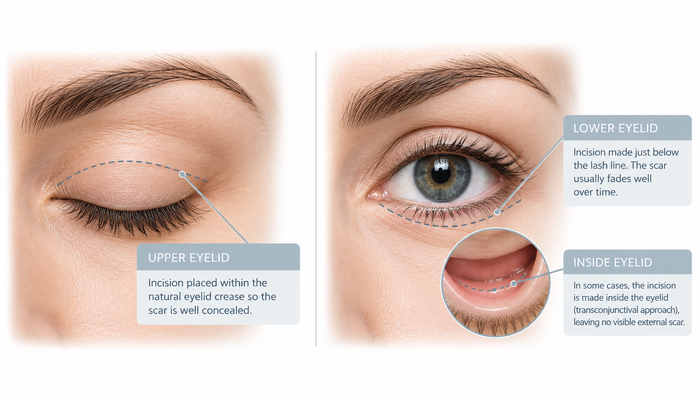
Typical incision position | Natural upper-eyelid crease | Beneath the lower eyelashes or inside the lower eyelid |
Tissue that may be treated | Skin, fat and sometimes a small amount of muscle | Fat, skin and, where needed, supporting tissues |
Other anatomy to assess | Brow position and eyelid position | Lower-eyelid position and support |
Can both areas be treated? | Yes, where treatment of both is considered appropriate | Yes, where treatment of both is considered appropriate |
The above table gives a general comparison only. The exact operation depends on what is found during the consultation.
What Is Upper Blepharoplasty?

Upper eyelid surgery treats the area between the eyebrow and the eyelashes.
It commonly involves excess upper-eyelid skin.
Fat or a small amount of muscle may also be treated where appropriate. The incision is generally placed within the natural upper-eyelid crease.
Patients may consider upper eyelid surgery when the lids look hooded or heavy. In some patients, excess upper-eyelid tissue can affect the upper visual field.
NHS guidance notes that excess upper-eyelid skin can affect vision in some patients. Visual-field testing may then be used.
The amount and type of tissue treated should depend on what is found during assessment. Surgery should not be based on removing a fixed amount of skin.
A Heavy Upper Eyelid Is Not Always Caused by Excess Skin

Upper-eyelid heaviness can involve more than the eyelid skin.
Brow position can change how much tissue sits above the eye. BAAPS guidance explains that a lower brow can make upper-eyelid hooding more noticeable. Eyelid surgery does not itself correct brow position.
NHS guidance also notes that brow ptosis means a lowered brow. It may cause or add to overhanging upper-eyelid skin.
Eyelid ptosis is a separate condition. It means that the upper eyelid itself droops. This is different from having excess skin above the lid.
In adults, ptosis can involve the muscle and supporting tissues that lift the eyelid.
These causes need to be told apart when a heavy-looking upper eyelid is assessed.
What Is Lower Blepharoplasty?

Lower eyelid surgery treats the area between the lower eyelashes and the cheek.
Under-eye bags are not always caused by skin excess.
Fat position, skin looseness and lower-eyelid position or support may also be relevant.
Depending on the operation, fat may be removed or moved to a different position. NHS guidance notes that fat may sometimes be moved rather than removed.
This may be relevant when hollow areas are also present beneath the eye.
Lower eyelid surgery may use an incision beneath the lower eyelashes or inside the lid. An incision inside the eyelid is known as a transconjunctival approach.
Some patients may also need additional lower-eyelid support. NHS guidance notes that the lower lid may sometimes need extra support.
This may help reduce the risk of retraction or ectropion.
Lower eyelid surgery is not one standard operation. The technique depends on what needs to be treated.
How Are Upper and Lower Blepharoplasty Incisions Different?

Incision position is one of the clearest differences between the two procedures.
In upper eyelid surgery, the incision is generally placed within the natural upper-eyelid crease.
In lower eyelid surgery, the incision may sit beneath the lower eyelashes. It may also be placed inside the lower eyelid.
A transconjunctival approach uses an incision inside the lower eyelid. This means there is no external lower-eyelid skin incision. However, there is still an internal surgical incision that needs to heal.
A separate guide to blepharoplasty scars covers scar position, visibility and maturation in more detail.
Can Upper and Lower Blepharoplasty Be Performed Together?
Upper and lower eyelid surgery may be performed during the same treatment. This may be considered when there is a reason to treat both areas and the patient is suitable for the proposed surgery.
An upper-eyelid concern does not automatically mean that the lower eyelids also need treatment. The same applies in reverse.
NHS guidance confirms that eyelid surgery can involve the upper lids, lower lids or both.
There should therefore be a clear reason to treat each area.
How Does a Surgeon Decide Between Upper, Lower or Both?
The decision depends on what is causing the concern.
Upper-eyelid assessment may consider | Lower-eyelid assessment may consider |
Amount and position of upper-eyelid skin | Under-eye fat position |
Fat distribution | Skin excess or looseness |
Eyelid crease | Lower-eyelid position and support |
Brow position | Previous eyelid surgery |
Upper-eyelid margin and possible ptosis | Eye health |
Visual symptoms where relevant | — |
Specialist NHS guidance advises a review of medical history. The eyes, eyelids, facial skin and deeper tissues should also be examined. Dry eyes, diabetes and thyroid eye disease may also affect suitability.
The process can be understood as:
concern → underlying anatomy → appropriate procedure
This is why two patients with similar-looking concerns may need different operations.
Are the Risks and Recovery Different?
Upper and lower eyelid surgery treat different areas. The details of surgery and recovery can therefore differ.
Possible risks include bleeding, infection, scarring, asymmetry, dry-eye symptoms and changes in eyelid position. Rare complications can affect vision.
Lower-eyelid surgery also requires attention to the position of the lid. Recognised complications include lower-lid retraction and ectropion. With ectropion, the lower eyelid turns away from the eye.
Recovery depends on the procedure and how the patient heals. It can also differ when both areas are treated.
A separate blepharoplasty recovery timeline can provide more detail without repeating it here.
Discussing Upper and Lower Blepharoplasty With Professor Miranda
Professor Ben Miranda provides upper and lower eyelid surgery in London, Hertfordshire and Essex.
During consultation, the eyelids and surrounding anatomy can be assessed. The patient's medical and eye history should also be reviewed. The changes they would like surgery to address can then be discussed.
Professor Miranda can explain which approach may be suitable. This may include upper surgery, lower surgery, both, or another option.
The risks, limits and likely recovery can also be discussed.
Patients considering eyelid surgery may also find two related guides useful: choosing a blepharoplasty surgeon in London and blepharoplasty for men.
Frequently Asked Questions
What is the main difference between upper and lower blepharoplasty?
Upper eyelid surgery may address excess skin, hooding and relevant fat. Lower eyelid surgery may address bags, protruding fat and skin excess beneath the eye.
How does someone know whether upper or lower blepharoplasty may be appropriate?
The decision depends on what is causing the concern. Upper-lid assessment may include skin, brow position and possible ptosis. Lower-lid assessment may include skin, fat position and eyelid support.
Can upper and lower blepharoplasty be performed together?
Yes. Surgery to both areas may be considered when both areas have a reason for treatment and the patient is suitable for the proposed surgery.
Does upper blepharoplasty treat under-eye bags?
No. Upper eyelid surgery treats the upper lid. Under-eye bags involve the lower lid and the area beneath the eye.
Is ptosis the same as excess upper-eyelid skin?
No. Ptosis means drooping of the upper eyelid itself. Excess skin can exist separately or alongside ptosis.
Does lower blepharoplasty always use an external incision?
No. Some lower eyelid procedures use an incision beneath the eyelashes. Others use an incision inside the lower eyelid. The approach depends on the operation being planned.