Blepharoplasty Scars: Where Are They and How Do They Heal?
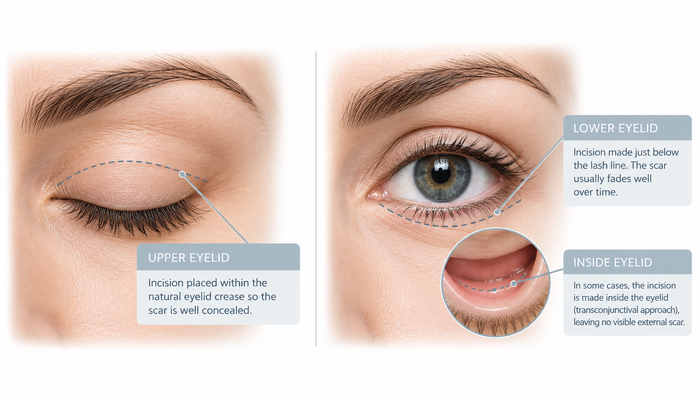
Blepharoplasty scars are a common concern for patients considering eyelid surgery. Their position and appearance depend partly on whether the upper eyelids, lower eyelids or both areas are treated.
Blepharoplasty involves an incision, so scar tissue forms as part of healing. Upper-eyelid incisions are generally placed within the natural eyelid crease. Lower-eyelid surgery may use an incision just below the lashes or inside the eyelid. Scars often become less noticeable as they mature, but their final appearance and healing time vary between patients.
Does Blepharoplasty Leave Scars?
Surgeons generally plan external eyelid incisions around natural folds or boundaries. This can make the resulting line less noticeable after it has healed.
This does not mean that blepharoplasty is scar-free.
Some scars remain more visible than others, and their final appearance cannot be guaranteed.
The NHS advises that scarring may remain visible and feel tight for a few months. It also lists noticeable scarring as a possible complication of eyelid surgery.
Where Is the Scar After Upper Blepharoplasty?

During upper blepharoplasty, the incision is generally placed along the natural fold of the upper eyelid. The scar can therefore sit within the crease when the eye is open.
The exact position and length of the incision depend on the patient’s anatomy and the proposed operation.
The incision may be easier to see while the eyelid is closed, particularly during early healing. Swelling, bruising and redness can also make the area appear more noticeable at first.
The natural crease can help to conceal the line, but it should not be described as invisible. The British Association of Aesthetic Plastic Surgeons, or BAAPS, explains that all surgery leaves scars and that scar appearance can vary.
Where Is the Scar After Lower Blepharoplasty?

Lower blepharoplasty may be performed using an external incision or an internal incision.
The appropriate approach depends on the concerns being treated, the amount and position of tissue, and lower-eyelid support.
It also depends on the findings from an individual assessment.
External Lower-Eyelid Incision
An external incision may be placed just below the lower eyelashes. This is sometimes called a subciliary incision.
The precise position and length of the incision vary between patients.
Because this approach passes through the skin, it creates an external scar.
The line may become less noticeable as healing progresses, but its final appearance depends on the operation and the patient’s healing response.
Internal or Transconjunctival Incision
A transconjunctival incision is made inside the lower eyelid. It may be considered for selected patients when the planned surgery can be performed without an external skin incision.
This approach does not leave a visible external skin scar from that incision. However, the wording “scar-free” can be misleading. The internal incision still creates tissue that must heal.
An internal approach is not suitable for every concern or every patient. The decision should follow an assessment of the lower eyelid, the tissues that may need treatment and the support around the eye.
Procedure or approach | General incision position | Visible external skin scar? |
Upper blepharoplasty | Natural upper-eyelid crease | An external scar forms but may be partly concealed within the fold |
Lower external or subciliary approach | Just below the lower eyelashes | Yes; the line may become less noticeable as it matures |
Lower internal or transconjunctival approach | Inside the lower eyelid | No external skin scar from that incision, although internal healing still occurs |
Patients comparing these approaches may also find it helpful to read Upper vs Lower Blepharoplasty: What’s the Difference?
Male patients can find broader planning information in Professor Miranda’s guide to blepharoplasty considerations for men.
How Do Blepharoplasty Scars Change as They Heal?

A newly closed incision should not be judged as a final scar. During early healing, the eyelids may be swollen or bruised. The incision may look red, feel firm or tight, and appear different on each side.
As healing continues, a scar may gradually soften, flatten and become paler. These changes do not happen on one fixed schedule.
A scar can continue to mature after the more obvious swelling and bruising have improved.
A 2025 review of postoperative scars following upper blepharoplasty noted that a set time at which a scar stops being immature cannot be defined.
Maturation can differ between patients and even between scars on the same patient.
This is different from the broader recovery period. A patient may feel ready to return to some normal activities before the scar has fully matured.
Questions about swelling, bruising, work and exercise are covered more fully in Blepharoplasty Recovery Timeline: What to Expect Week by Week.
What Can Affect Blepharoplasty Scar Appearance and Healing?
Several factors may influence how an eyelid incision heals. No single factor can predict the final appearance.
Incision Position and Wound Closure
The location of the incision, the way it is closed and the amount of tension across the healing tissue can affect scar development. These factors form part of surgical planning.
Individual Healing Response
Patients do not all form scars in the same way. A previous history of thick, raised or unusually pigmented scars may be relevant and should be discussed during consultation.
Differences can also occur between the right and left eyelids. BAAPS notes that scars may differ in colour, position or appearance and may not be symmetrical.
Smoking and Nicotine
Smoking and nicotine can reduce blood flow to tissues and interfere with wound healing. BAAPS associates smoking and nicotine use with poorer healing and scarring.
Patients should provide accurate information about smoking, vaping and nicotine products. Any advice about stopping should come from the appropriate clinical team.
Medical Conditions and Medicines
Some medical conditions can affect tissue repair. Medicines may also influence bleeding, inflammation or healing.
Professor Miranda should be told about relevant medical conditions, previous operations and all medicines or supplements being taken.
Prescribed medicine should not be stopped unless the appropriate clinician advises this.
Problems During Healing
Wound disruption, infection or delayed healing may affect scar appearance. These outcomes are not inevitable, but they are among the reasons why follow-up and appropriate postoperative advice matter.
What May Help Support Appropriate Healing?
Patients should follow the instructions provided by their own surgical team. Advice may vary according to the procedure performed and the individual’s medical needs.
General precautions may include:
keeping the area clean as instructed;
using prescribed ointment or eye drops only as directed;
avoiding rubbing, pulling or disturbing the incision;
attending planned follow-up appointments; and
protecting the eyes from sun and wind during recovery, including by wearing sunglasses when advised.
Products marketed for scars should not be applied near a healing eye without clinical advice.
The 2025 clinical review found that no clear postoperative standard of care has been established for upper-blepharoplasty scarring.
It also found uncertainty about whether any particular ointment is better than another. Scar treatments should therefore not be treated as universally suitable.
When Should a Patient Contact the Clinic?
Some temporary swelling, bruising, tightness and scar visibility can occur during recovery.
However, a patient should contact the clinic where the surgery was performed if severe pain or other unexpected symptoms develop. NHS advice is to do this as soon as possible.
Concerns about a scar that remains raised, irregular, uncomfortable or more visible than expected should also be discussed during clinical follow-up.
Online photographs cannot determine whether an individual incision is healing normally.
Discussing Blepharoplasty Scars During a Consultation

During a consultation, Professor Ben Miranda can assess the upper and lower eyelids and discuss the changes the patient would like to address.
Patients who are still comparing practitioners may also find this guide to choosing a blepharoplasty surgeon in London helpful.
The consultation can cover the likely incision position and whether an internal or external lower-eyelid approach may be appropriate.
Relevant healing history, limitations, risks and expected aftercare can also be discussed in relation to the proposed procedure.
No consultation can guarantee that a scar will become invisible.
The purpose is to help the patient understand the proposed approach and form realistic expectations before deciding whether to proceed.
Frequently Asked Questions
Are Blepharoplasty Scars Permanent?
Scar tissue is permanent, although the visible line may become less noticeable as it matures. Complete disappearance should not be promised.
Can Lower Blepharoplasty Be Performed Without a Visible External Scar?
In selected cases, a transconjunctival incision may avoid an external skin scar, although internal tissue still needs to heal. Suitability depends on the anatomy and concerns being treated.
Can Upper- and Lower-Eyelid Scars Heal Differently?
Yes. Incision location, technique, wound tension and individual healing can differ, so one scar may mature differently from another.
Can a History of Raised or Pigmented Scars Matter?
A history of thick, raised or unusually pigmented scars may be relevant and should be discussed during consultation.
When Should a Blepharoplasty Scar Be Reviewed?
Severe pain or unexpected symptoms should be reported promptly to the treating clinic. Other concerns about scar appearance, discomfort or delayed healing can be assessed during follow-up rather than diagnosed from appearance alone.
Arranging a Blepharoplasty Consultation
Patients considering blepharoplasty can arrange a consultation with Professor Miranda to discuss their concerns, medical history and the incision that may be involved. Recommendations can then be based on an individual assessment rather than a general expectation about scarring.