How to Choose a Blepharoplasty Surgeon in London
Updated: Sep 30

Choosing a surgeon for blepharoplasty is an important decision. Eyelid surgery takes place close to the eye, so patients should look beyond a website, reviews or before-and-after photographs.
Patients may find it helpful to consider the whole treatment pathway: registration and specialist training, eyelid surgery experience, how suitability is assessed, where surgery takes place, how risks are explained and what aftercare is provided.
The same checks should be used for every surgeon being considered, including Professor Ben Miranda.
A Practical Verification Check Before Consultation
Before booking a consultation, patients can independently verify several important points:
Patients can search the surgeon's name on the GMC register and check their registration, licence to practise and Specialist Register status.
If the surgeon refers to Royal College of Surgeons cosmetic surgery certification, patients can check the RCS register and the area covered.
Patients can ask where the operation would take place and check the hospital or clinic on the CQC register.
Patients should confirm that the consultation will be with the surgeon who would perform the operation.
These checks do not identify one surgeon as the best.
They help patients distinguish information that can be independently verified from marketing claims and provide useful context before consultation.
GMC Registration and Relevant Specialist Training
In England, cosmetic surgery must be performed by a doctor registered with and licensed by the General Medical Council (GMC).
This is the first point to check.
GMC registration does not mean that a doctor is on the Specialist Register for the area linked to the procedure.
The Royal College of Surgeons strongly advises patients to choose a surgeon on the GMC Specialist Register for the relevant area of practice.
Surgeons who perform blepharoplasty may come from different specialist backgrounds.
These can include plastic surgery and ophthalmology with oculoplastic practice.
A title alone does not show whether a surgeon is suitable for a particular patient.
Patients should consider specialist registration, relevant training, eyelid-specific experience and how the surgeon assesses the individual concern.
The Intercollegiate Cosmetic Surgery Board oversees the Cosmetic Surgery Board Certification Scheme, which is supported by the Royal College of Surgeons of England.
The certification applies to specific areas of cosmetic surgery and can be checked independently.
Specific Experience in Blepharoplasty

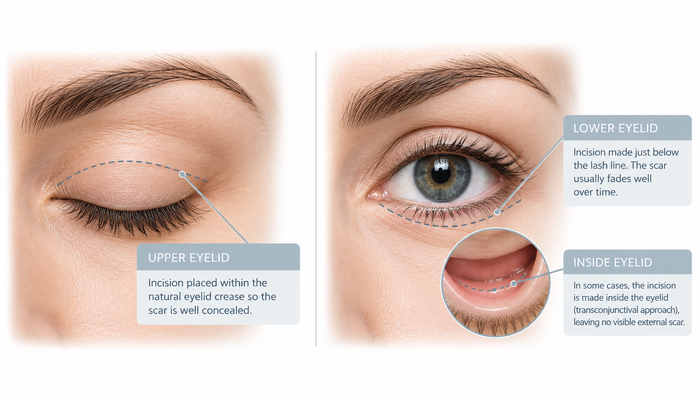
Blepharoplasty is not the same operation for every patient. Upper and lower eyelid surgery address different concerns and may use different techniques.
The NHS recommends asking how many of the relevant procedures the practitioner has performed. Patients can also ask:
whether the surgeon regularly performs upper, lower or both types of blepharoplasty
which procedure is being recommended and why
what could change the surgical plan
what experience the surgeon has in managing complications or revision surgery, where relevant
The surgeon should be able to explain the proposed approach in clear language and relate it to the patient's anatomy and concerns.
How Surgeons Decide Whether Blepharoplasty May Be Suitable
Choosing a surgeon is also about how carefully they decide whether the operation is appropriate for the patient.
Upper eyelid hooding is not always caused by excess eyelid skin alone.
Cambridge University Hospitals notes that brow droop, also called brow ptosis, can sometimes cause or add to overhanging upper eyelid skin. A different or combined procedure may then need to be discussed.
Assessment may also include eyelid position, true eyelid ptosis, previous eye surgery, dry-eye symptoms and other aspects of eye and eyelid health.
Existing dry eyes can matter because blepharoplasty may cause or worsen dryness in some patients.
A consultation should not simply confirm surgery. The surgeon should be willing to explain when blepharoplasty alone may not address the main concern, when another approach may need to be considered, or when surgery should not be advised.
What a Blepharoplasty Consultation Should Cover

The consultation allows patients to understand how carefully the surgeon assesses suitability and how clearly the proposed treatment is explained.
The NHS advises patients to meet the person who will perform the procedure before making a final decision.
Depending on the patient, a blepharoplasty consultation should cover:
concerns and what the patient would like to address
relevant medical and eye history
examination of the eyelids and nearby anatomy
the proposed procedure and anaesthetic
expected recovery
risks and limitations
alternatives, where relevant
follow-up, aftercare and costs
Patients should have enough time to ask questions and understand the reasoning behind any recommendation.
The aim is to support an informed choice, not to pressure someone into booking surgery. There is no obligation to proceed, and no decision needs to be made on the day.
Risks and the Management of Complications
All surgery has risks, including blepharoplasty.
Possible complications can include bruising and swelling, infection, scarring, asymmetry, dry eye and problems closing the eyelids.
Severe bleeding around or behind the eye is rare, but it can cause serious visual problems and needs urgent treatment.
Risk should be discussed in relation to the individual patient and the operation being considered.
Patients should understand which risks may be relevant, how complications would be managed if they occurred and what support would be available if a problem developed.
Reviewing Before-and-After Photographs

Before-and-after photographs can show the type of work a surgeon performs, but they cannot guarantee an individual result.
Patients can ask to see photographs of procedures the surgeon has personally performed.
They can look for photographs of patients with similar concerns and ask which procedure was carried out and when the after photograph was taken.
Photographs can provide useful context, but they should not replace consideration of qualifications, clinical assessment, communication and aftercare.
Where Blepharoplasty Surgery Takes Place
The surgeon is one part of the treatment pathway. Patients should also understand where the operation would take place and how the facility is regulated.
Independent hospitals and clinics providing cosmetic surgery in England must be registered with the Care Quality Commission (CQC).
The CQC regulates surgical cosmetic procedures, including eyelid and brow surgery.
Patients can check the provider's registration and inspection information.
They can also ask how an unexpected problem would be managed and what arrangements are in place if additional care is required.
What Patients Should Know About Aftercare Before Booking
Aftercare should be clear before surgery because the period after an operation remains part of the overall treatment.
Patients should ask what aftercare is included, who will look after them and what to do if something goes wrong.
Before booking, patients should know when follow-up takes place, who to contact with a concern and what arrangements apply if further assessment or treatment is needed.
Red Flags When Comparing Blepharoplasty Surgeons
Certain features may warrant further questions before a patient decides to proceed:
registration or specialist credentials are difficult to verify
there is little evidence of relevant eyelid surgery experience
risks or limitations are dismissed
a particular result is guaranteed
the patient is pressured by a limited-time offer or discount
the operating facility or aftercare arrangements are unclear
Patients should not feel rushed into making a decision.
They should allow at least two weeks after consultation to consider whether to proceed with surgery.
Questions Patients May Ask a Blepharoplasty Surgeon
Is the surgeon on the GMC Specialist Register, and in which specialty?
What training and experience does the surgeon have in the type of blepharoplasty being considered?
Why may blepharoplasty be suitable for the patient?
Is anything else contributing to the patient's eyelid appearance?
What may realistically be achieved for the patient's anatomy?
What are the main risks for the individual patient?
Where will surgery take place?
What aftercare is included?
Who should the patient contact if there is a concern after surgery?
Professor Ben Miranda's Blepharoplasty Experience and Credentials

Professor Ben Miranda is a Consultant Plastic Surgeon on the GMC Specialist Register for Plastic Surgery.
He holds the FRCS(Plast) qualification, is a member of BAAPS and BAPRAS, and completed two Aesthetic fellowships after his specialist Plastic Surgery training.
His credentials can also be checked independently.
The Royal College of Surgeons' current Board Certified Cosmetic Surgeons register lists Professor Miranda as certified in cosmetic surgery of the periorbital region.
Blepharoplasty is listed among his areas of practice.
Professor Miranda performs both upper and lower blepharoplasty in London and Essex.
Credentials are only one part of deciding whether a surgeon may be appropriate for an individual patient.
A consultation is still needed to assess the patient's concerns, anatomy, suitability, potential benefits, limitations and risks before deciding whether surgery should be considered.
Frequently Asked Questions
What qualifications should a blepharoplasty surgeon have?
In England, the surgeon must be registered with and licensed by the GMC. The RCS also strongly advises checking relevant Specialist Register status. Relevant eyelid surgery training and experience should also be considered.
Should patients choose a plastic surgeon or an oculoplastic surgeon for blepharoplasty?
Both plastic surgeons and ophthalmologists with oculoplastic training may have relevant eyelid expertise. Patients should consider the individual surgeon's registration, training, blepharoplasty experience and approach to assessment.
How can patients check a blepharoplasty surgeon's GMC status?
Patients can search the GMC online medical register by name. It shows registration, licence to practise and Specialist Register status.
What should patients ask during a blepharoplasty consultation?
Patients can ask about qualifications, experience, suitability, what may realistically be achieved, risks, recovery, the surgical facility and aftercare.
Should patients check whether the clinic is CQC registered?
Yes. Independent cosmetic surgery hospitals and clinics in England must be CQC registered. Patients can check this information online.
How important is aftercare after blepharoplasty?
Aftercare forms part of the overall treatment pathway. Patients should know when follow-up takes place, who to contact with concerns and what support is available if recovery does not go as expected.
Blepharoplasty Consultation with Professor Ben Miranda
Patients considering upper or lower blepharoplasty can arrange a consultation with Professor Ben Miranda to discuss their concerns, eyelid anatomy and whether surgery may be suitable.
The consultation provides an opportunity for the patient's anatomy, concerns and suitability to be assessed and for the proposed procedure, expected recovery, possible risks, limitations and alternatives to be discussed before deciding whether to proceed.